
Production Resources and SOPs
What is done, where it can be done and how long it takes — kept apart and linked together.
OMENTA deliberately separates three concepts: the operation says what is done to the product, the work centre where it can be done, and the capability on which machine it is done and how long it takes. The calendar derives day-by-day net capacity from the weekly pattern and exceptions. The SOP (standard operating procedure) holds each product's ordered work steps; whether a product is made discretely, by process or mixed is derived from the flow types of those steps.
What you gain with OMENTA
- An SOP says what a step is, not where it runs; the machine is picked from the capability list at scheduling time.
- If a product's steps mix flow types it is flagged as mixed automatically; the production type is read from data, not typed in.
How it works
From resources to a standard process in four steps.
-
1
Define the work centres
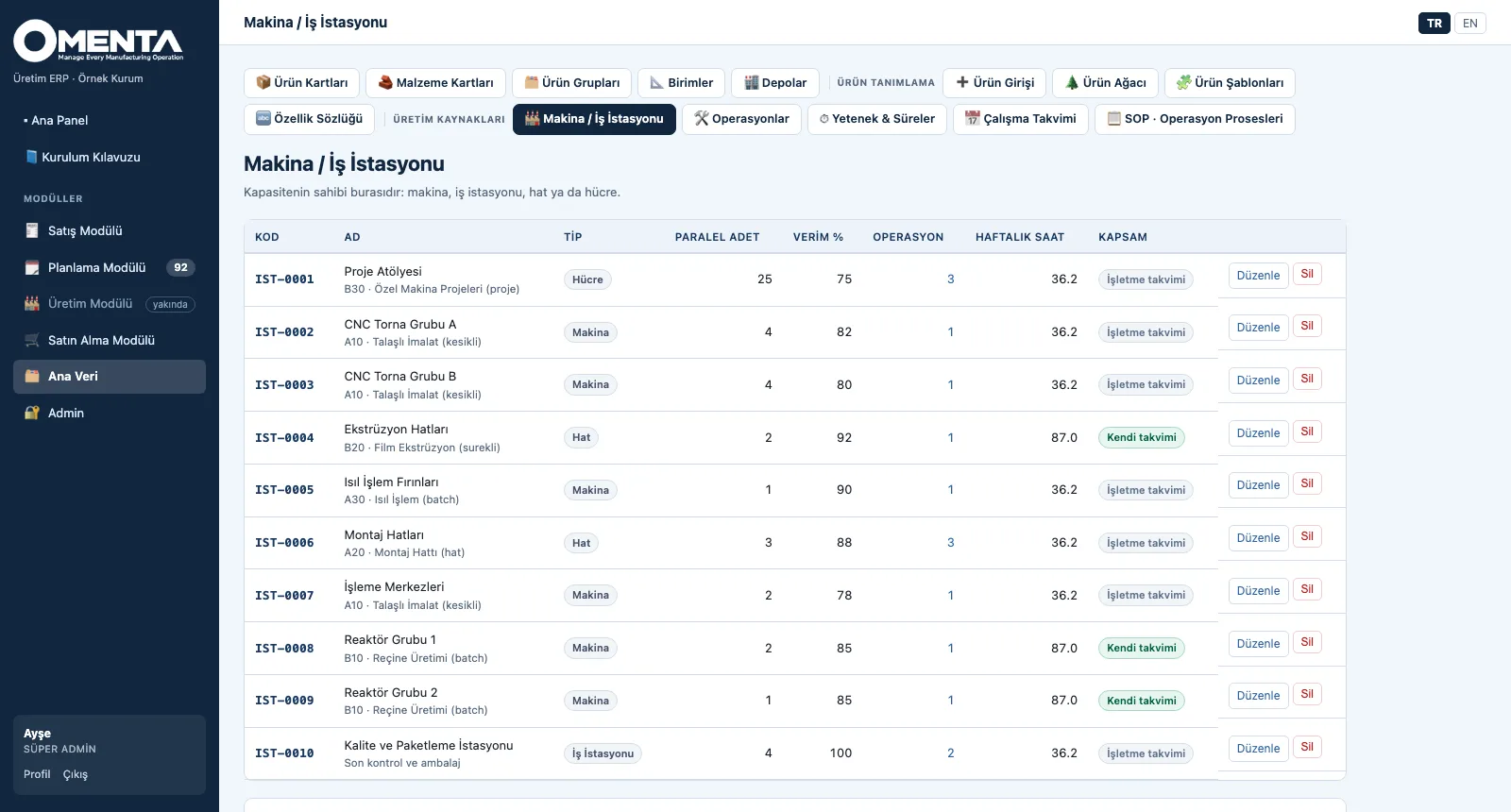
Each work centre with its type, parallel units and efficiency; weekly net hours and whether it uses the plant calendar or its own show in the list.
-
2
Enter the capabilities
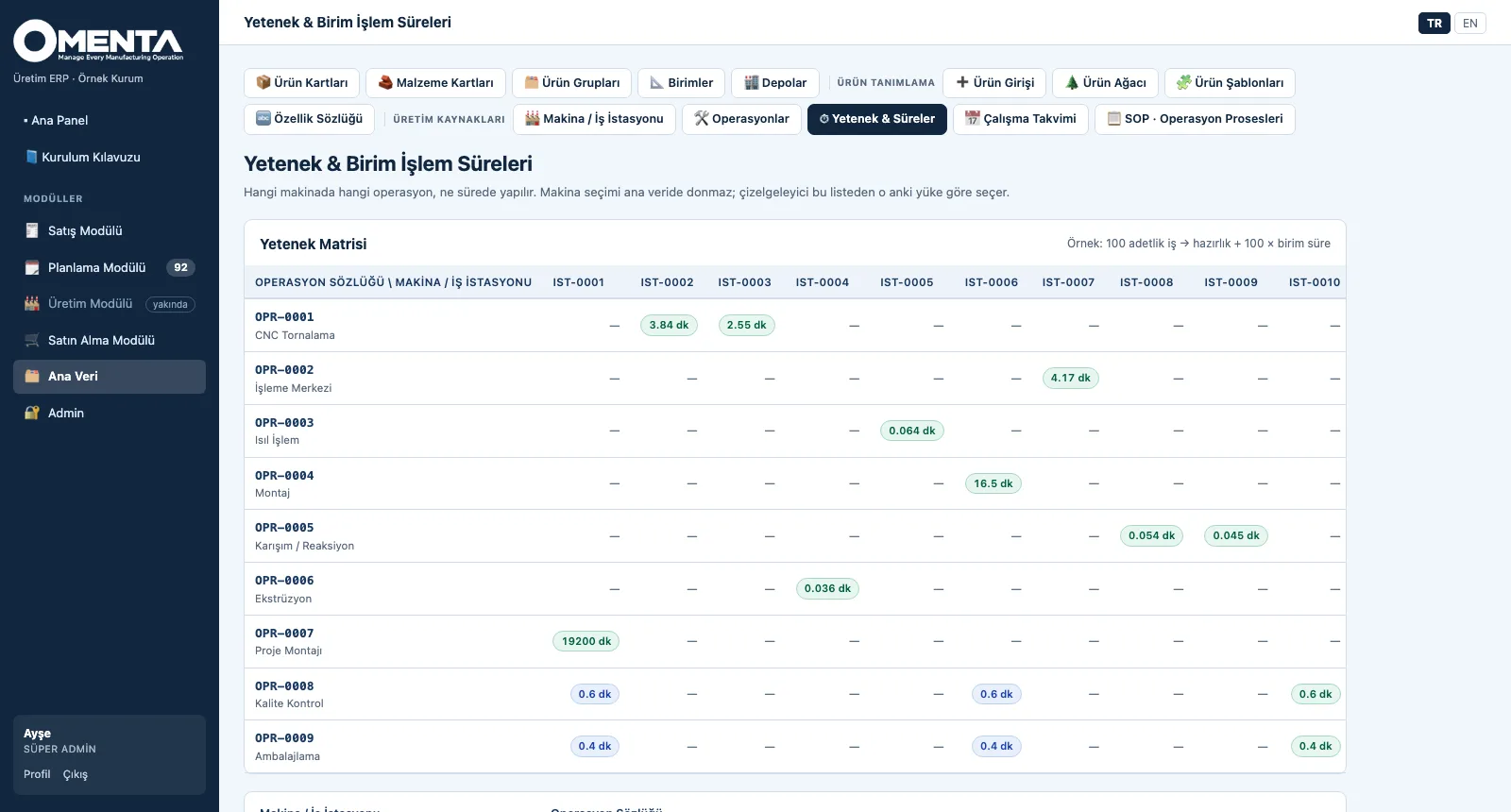
The matrix shows which operation runs on which machine and in how many minutes; click a cell to enter time, setup, preference and availability.
-
3
Set the calendar
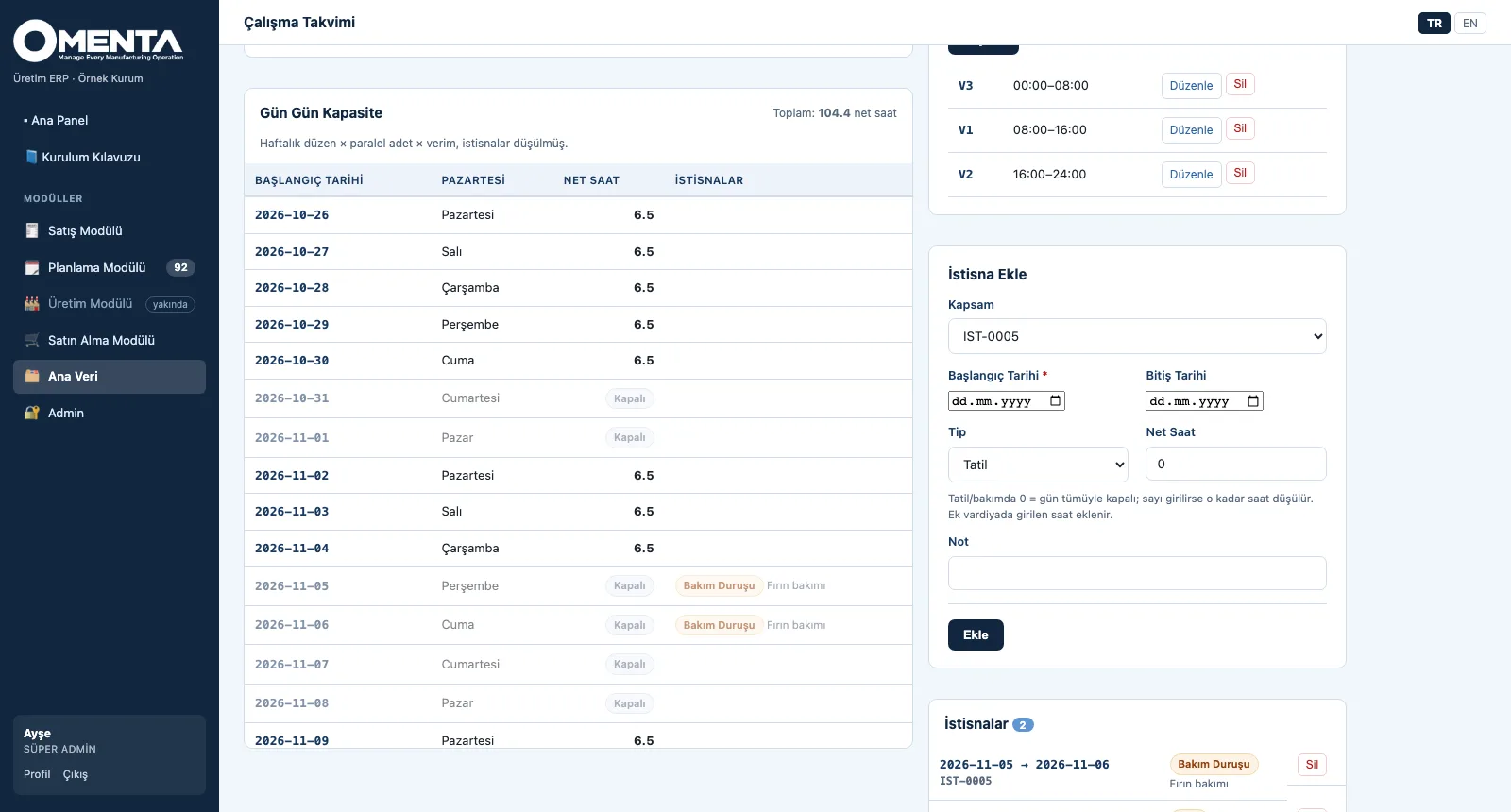
Weekly pattern × parallel units × efficiency, net of exceptions, as day-by-day capacity; maintenance and holiday days show as closed.
-
4
Write the SOP
Steps are saved together as a table: operation, predecessor, flow type, waiting time, critical step and consumed material; a machine and time suggestion appears under each step.
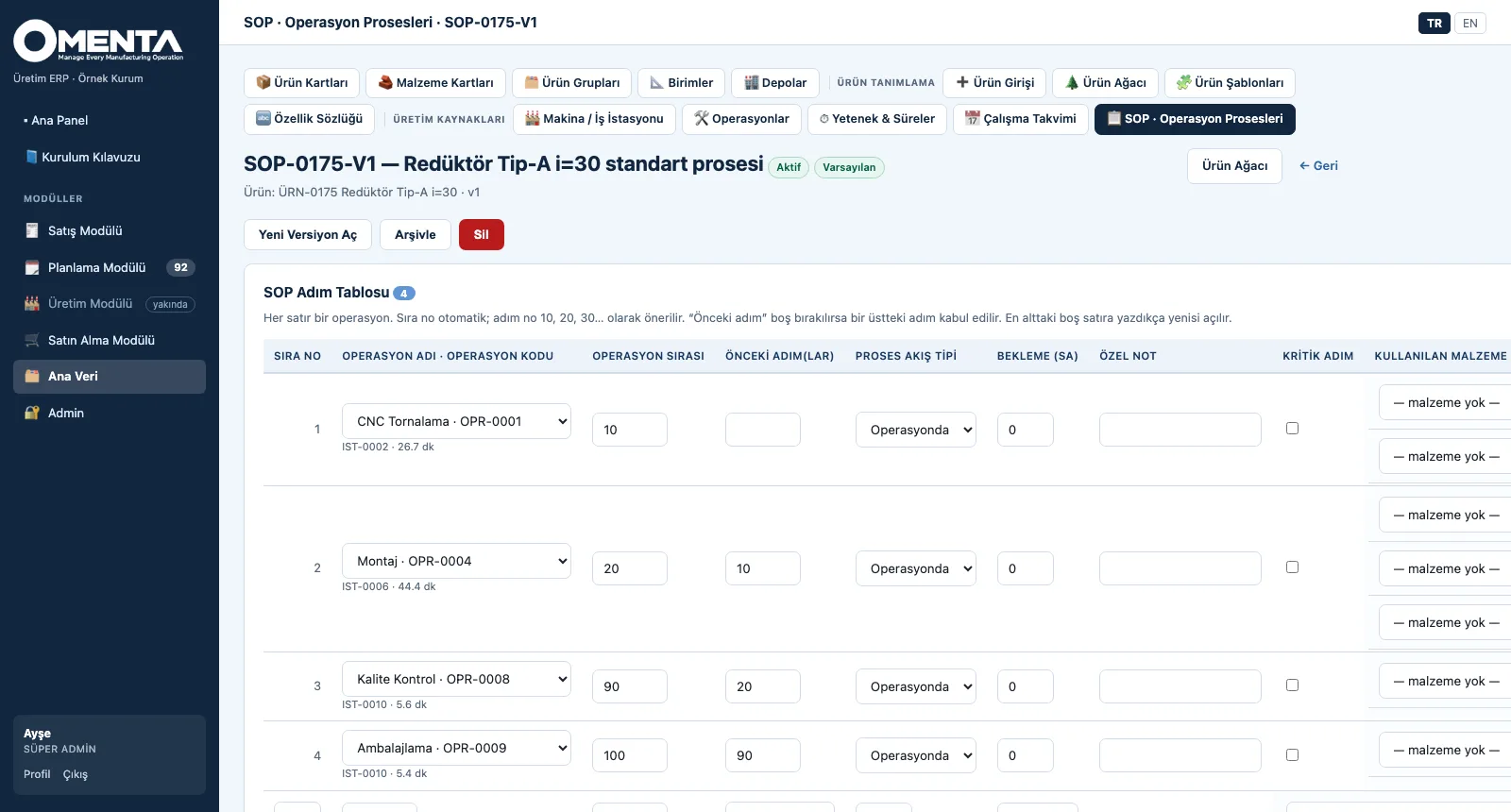
Screens are shown with sample company data; the application interface is in Turkish and English.
Purpose
To bring production resources and standard times into a single correct source that planning and work orders can rely on.
Features
- Work centres: machine, work station, line or cell; parallel units, efficiency percentage, hourly cost, bottleneck flag, weekly net hours and an own calendar
- Operation dictionary: each operation's default process flow type — discrete, batch, continuous, line or project — and the number of machines able to do it
- Capability matrix: operation × work centre unit processing time (min/unit), setup time, efficiency, preference and availability (available / backup / blocked); an item-specific time overrides the general one
- Working calendar: shifts (breaks deducted, night shifts supported), a plant-wide or work-centre-specific weekly pattern; holiday, maintenance and extra-shift exceptions; day-by-day net capacity
- SOP: steps 10, 20, 30…, predecessors for serial / parallel / merging flows, waiting time after a step (cooling, drying), critical step, quality note and material consumed at the step; an estimate of the total time
- SOP governance: versions (SOP-0001-V1 → V2), draft / active / archived, a default SOP and a warning for made items without an SOP
Benefits
- Machine choice is not frozen in master data; the option list stays ready
- Capacity is read from the calendar day by day, in net hours
- The process only changes through a new SOP version
Who uses it
Process and industrial engineers, production managers, planning teams, maintenance and quality owners.